
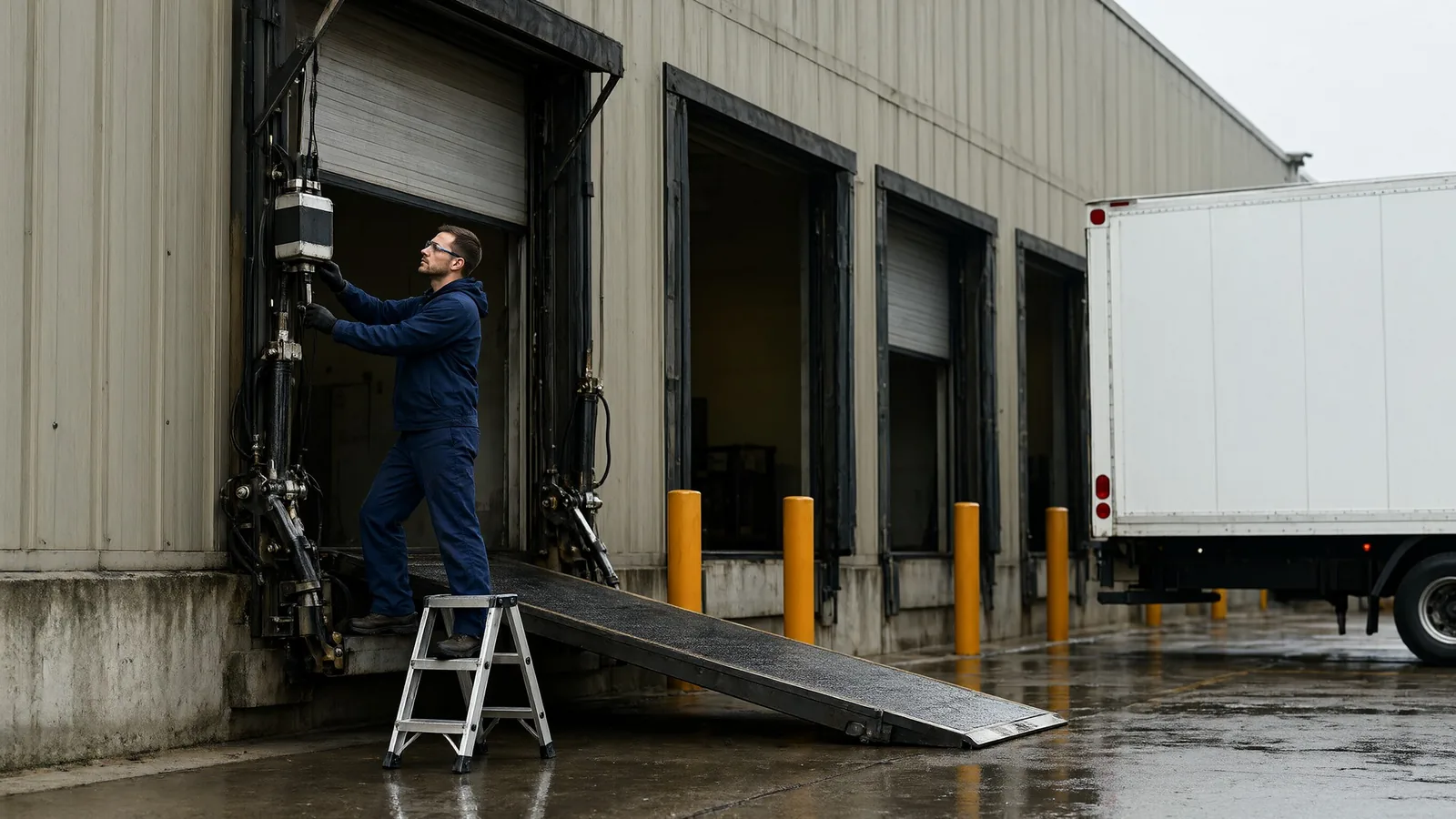
Commercial garage door repair is service work on a door a business cannot spare — sectional overhead doors, rolling steel shutters, high-speed doors, the operators that drive them, and the dock equipment beside them.
It is mostly a cycle-count problem, not an age problem. A home door runs three or four times a day; a loading bay door can run forty or fifty, five or six days a week. Every spring, cable, roller and operator is rated against that number, so parts that last a decade at home wear out in a year or two on a dock.
We serve retail, warehouse, industrial and strata buildings across Langley, Surrey, Burnaby, Richmond, Coquitlam and the rest of Metro Vancouver. Commercial service runs 24/7, because business hours are not the only hours a door fails.
Which commercial doors do we repair?
Four door types cover most of the Lower Mainland, and each one fails differently.
- Sectional overhead doors — panel construction like a home door, scaled up, usually insulated and powered. The common commercial door on retail and light industrial buildings.
- Rolling steel doors — the corrugated curtain that coils onto a barrel above the opening. Warehouses and storefronts. Tough, and unforgiving of impact.
- High-speed and fabric roll-up doors — fast-cycle doors between temperature zones, wash bays or clean areas, usually driven by a VFD.
- Fire-rated and fire-shutter doors — these have to drop and latch on signal, so the drop mechanism, fusible link and reset need documented testing rather than guesswork.
Sectional doors and their hardware are specified to ANSI/DASMA 102, which sets construction and cycle-life requirements. That is why a commercial door is bought on cycles rather than years.
Next to the door sits dock equipment: levellers, seals, shelters and vehicle restraints. They fail on their own schedule, and a failed leveller makes a bay unusable even when the door itself is fine.
What fails first on a dock door?
Springs and cables
A torsion spring is a consumable rated in cycles, not years. Order the same door with a 50,000-cycle spring instead of a 10,000-cycle one and you get five times the service from the same installation labour. At 250-plus cycles a week, a standard spring reaches the end of its rating in a fraction of the time it would take at home — and a snapped spring on a door that stands open all day is a door that will not close that night.
Cables follow the spring. They wear at the drum, jump the groove under shock load, and eventually strand. A cable that has jumped is also what pulls a door crooked and starts wearing one side of the track.
Operators, photo-eyes and controls
Commercial operators take heavier loads, slower and hotter than residential units. Gearbox wear, brake failure, VFD faults and control-board failures are the usual retirements. The most common control fault we find is not a board at all: it is a photo-eye or edge device knocked out of alignment by a pallet or a forklift and never re-checked.
Tracks, rollers and impact damage
Impact is the signature commercial failure, and the most common reason for an overhead door repair call. A hit panel distorts the door, a distorted door loads the track, and a loaded track wears rollers out fast. Rolling steel dents and binds; sectional doors twist and scrape. Both are repairable up to a point, and that point is usually the second hit in the same place.
Dock levellers, seals and shelters
Levellers fail at the lip, the hinge and the hydraulics. Seals and shelters tear where the trailer edge catches them. Those are not door faults, but they are the reason a bay goes out of service while the door itself is fine.
Why does my dock door close on constant pressure but not automatically?
That symptom has one usual cause, and it is a safety device rather than the motor. Hold the button and the door closes; let go and it stops. The operator has fallen back to constant-pressure-to-close because it can no longer confirm a monitored entrapment device.
Under UL 325 (ANSI/CAN/UL 325 in Canada), commercial operators manufactured after August 2010 have only two compliant configurations: constant pressure to close, or a monitored external entrapment protection device such as a photo-eye or an edge sensor. There is no third option. An operator triggered by a timer, a radio remote or a building automation command without monitored protection does not comply, and constant pressure is not a legal way to run an unattended door.
The fix is rarely exotic. A forklift clips a photo-eye bracket, the lens goes out of line, the operator loses its monitored device and drops into constant pressure. Ten minutes with a level and a test cycle usually ends it. What does not end it is taping over the lens, disconnecting the device, or leaving the door on constant pressure and asking staff to watch it.
Where should commercial photo-eyes be mounted?
Parallel to the floor, and no more than six inches (15 cm) above it. That is the installation requirement in DASMA Technical Data Sheet 382. Mounting a sensor higher, which some technicians have done in an effort to protect vehicles, violates UL 325 and the manufacturer's instructions, and it exposes the dealer and the building owner to liability. If vehicle protection is wanted, add a second set of devices — ancillary protection never replaces the primary monitored device.
The residential version of this fault, and the 60-second checks that catch it, is in our guide to why a garage door won't close. The logic is identical; the hardware is heavier.
What does commercial garage door maintenance include?
A maintenance agreement earns its keep when a door runs daily and downtime is expensive. It does not for a door that cycles twice a week. The interval should follow cycles rather than the calendar, which is why a dock door and a storage-room door in the same building rarely belong on the same schedule.
A proper commercial garage door maintenance visit covers:
- Spring, cable and drum inspection with the cycle count recorded, so replacements are scheduled instead of reactive.
- Roller, hinge and track wear, plus fastener torque.
- Operator brake, gearbox, chain or belt tension, and limit calibration.
- Photo-eye and edge sensor testing in the configuration the door actually runs, not just a reverse test at the wall button.
- Panel, bottom bar and guide condition, including impact damage that is heading for a track problem.
- Dock leveller, seal and shelter condition where they serve the same opening.
- Fire door drop testing and record-keeping where the assembly is rated.
What it should never be is a lubrication visit with an invoice. If the technician cannot tell you the cycle rating of your springs and roughly how much of it is left, the contract is not doing much. The same discipline at home is in our garage door maintenance checklist.
Is a roll-up door repairable, or does it need replacing?
Usually repairable. Roll-up door repair is mostly slat, barrel and guide work: a dented curtain, a bent bottom bar, a guide pushed out of line by a trailer, or a barrel that no longer winds evenly. Slats replace individually, and a bottom bar is a wear item on any door that takes hits.
Replacement starts to win when the curtain is creased across several slats, the guides are bent over a long run, or the door has been hit in the same place twice. At that point you are buying labour, parts and downtime on a door that will fail again. Our repair-or-replace guide applies the same test to any door, and age is not the deciding factor.
What does a bay door failure actually cost a facility?
We do not quote national averages for lost revenue, because they vary wildly by business. The local pattern is consistent: a bay door that will not open delays every inbound delivery, a door that will not close leaves stock and equipment exposed overnight, and a door stuck halfway is a safety hazard that usually means stopping work in that bay.
That is why commercial calls are triaged differently from residential ones. Three questions decide the response:
- Is the door stuck open, stuck closed, or unsafe to operate?
- Is a delivery or shift blocked right now?
- Can the door be isolated safely until we arrive?
A door that opens on its own is a different fault, and on a commercial building it is a security problem too: usually a stuck wall button, a stray signal or a failing board. The causes are the same ones in why a garage door opens by itself.
What should you have ready when you call?
Commercial diagnostics go faster with five pieces of information:
- A photo of the door and the opening, including any damage.
- The door type — sectional, rolling steel, high-speed — and approximate size.
- The operator make and model, or a photo of the data plate.
- What the door does when you press the control: nothing, moves and stops, reverses, or runs without moving the door.
- Whether the door can be left safely as it is.
With those, we can often load the right spring, cable set or control board before leaving the shop, instead of making a second trip.
When is it time to call?
- A dock or bay door is stuck open, stuck closed, or unsafe.
- A door will not close on automatic but closes on constant pressure.
- Impact damage, a bent track, or a door that has come out of its guides.
- An operator that runs but does not move the door, or trips repeatedly.
- A sensor or edge device that has been knocked, bypassed or disabled.
- A preventive maintenance schedule that has lapsed.
Commercial service runs around the clock. Call 604-388-9868 or send the details — for after-hours work, the phone is faster. We also handle commercial door and operator installation and commercial garage door repair across the Lower Mainland.
Sources and standards
- DASMA Technical Data Sheet 382 — the two compliant configurations for commercial operators built after August 2010, and the six-inch photo-eye mounting rule.
- 16 CFR Part 1211 — the US federal rule that adopts UL 325 for residential operators; the commercial entrapment requirements above come from the same standard.
- UL Standards & Engagement — automatic garage door standards: how the layers of entrapment protection work.