
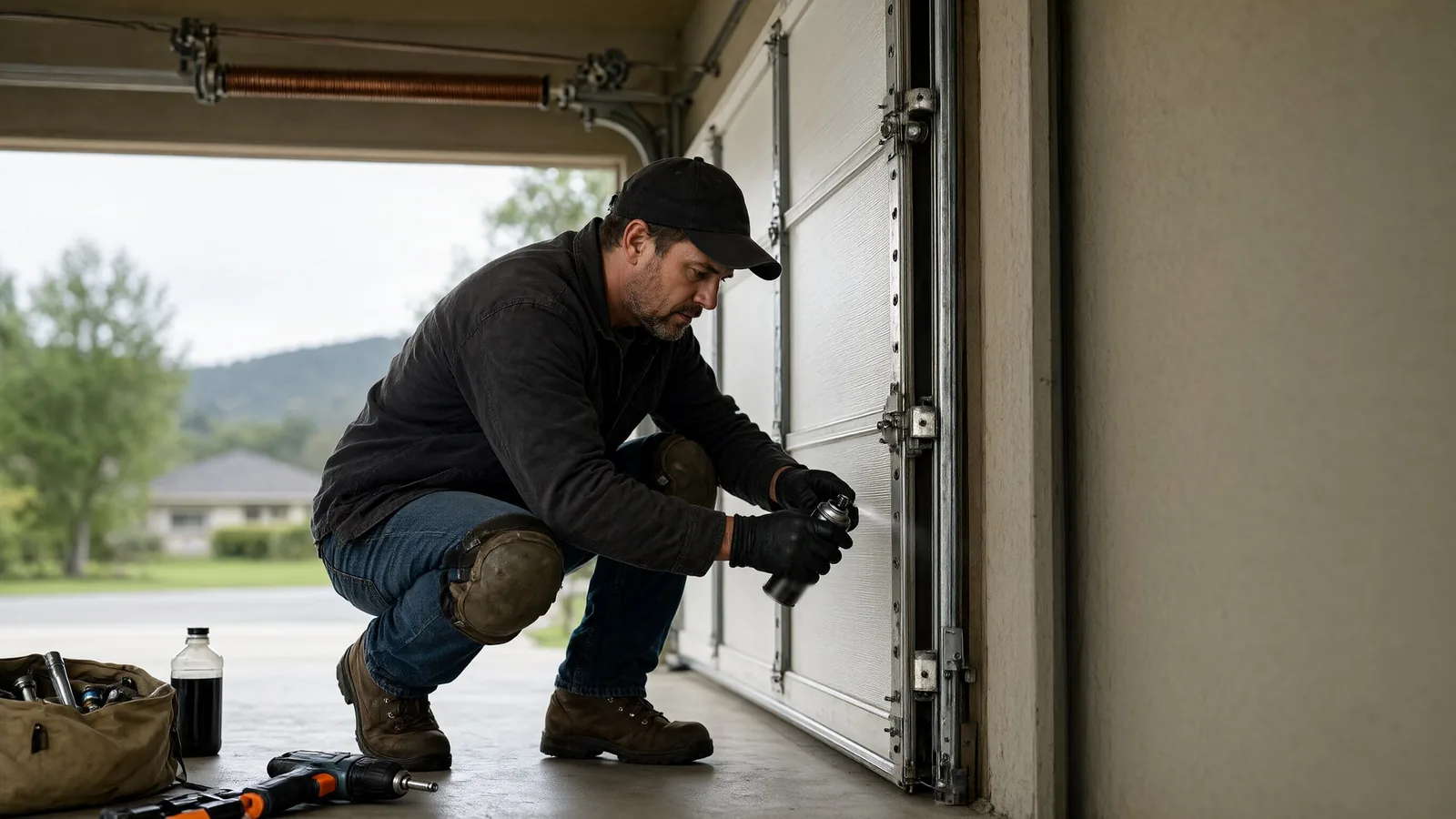
Service your garage door once a year, test the safety reverse once a month, and lubricate the hinges, rollers and bearings every three months. That is the entire routine. Everything else on this page is a five-minute check you can do in runners.
Most garage door failures are not sudden. Springs fatigue over thousands of cycles, rollers seize over months of damp air, and tracks drift until the door binds. A routine catches all three while they are still cheap, and the monthly test is the one that stops a sensor fault becoming a door that closes on someone.
This checklist is built for Lower Mainland conditions, because our failure pattern is not the same as a dry climate. Rain from October to March, road salt dragged in off the commuter routes, and a freeze-thaw cycle that welds the bottom seal to the slab do more damage here than cold alone.
The checklist at a glance
| Task | How often | Time |
|---|---|---|
| Test the safety reverse with a 2x4 | Monthly | 2 min |
| Check sensor LEDs, height and alignment | Monthly | 1 min |
| Balance the door by hand | Every 3 months | 5 min |
| Lubricate hinges, roller stems and bearings | Every 3 months | 10 min |
| Wipe tracks, check seals and fasteners | Every 3 months | 10 min |
| Rinse salt and grit, dry, re-lubricate | Before and after winter | 20 min |
| Springs, cables, limits, force and full service | Once a year | Technician |
If the door is already misbehaving rather than just due for a service, work through the seven reasons a garage door won't close first. This checklist assumes a door that runs.
How often does a garage door need servicing?
Once a year for a residential door in a climate like ours, and that is a service, not an oiling. Monthly you test. Quarterly you lubricate and look. Annually someone measures springs, cables, balance and opener force with the door disconnected and the numbers in front of them.
Two things move that interval. A door that runs many times a day, or a commercial door, accumulates cycles faster than one used twice a day. And a door that lives on a salt route or faces the weather needs its seasonal rinse more than it needs a shorter service interval.
Cycles are the unit that matters. Springs retire on cycles, not birthdays, which is why a five-year-old door on a quiet street can outlast a two-year-old door on a busy one.
Every month: test the safety reverse
This is the check that matters, and it takes two minutes. Modern openers carry two separate layers of entrapment protection, and you test them differently. The first is built into the operator: under 16 CFR Part 1211, a closing door must begin reversing within two seconds of contact with an obstruction. The second is the photo-eye pair at the bottom of the tracks, which should stop the door before it touches anything at all.
Your opener manual describes this test. Do it the way the manual says, not the way a video does.
How to test the safety reverse in two minutes
- Open the door with the wall control.
- Lay a 2x4 flat on the floor in the middle of the opening, about 38 mm (1.5 in) thick.
- Close the door. It must reverse on contact with the wood, not press down on it.
- Open it again, then pass your leg through the sensor beam while it closes. It must reverse immediately.
- Pull the wood out and listen for any new noise as the door finishes.
Repeat the beam test at the middle of the opening and near each track. A sensor that passes dead centre and fails elsewhere is usually out of line rather than dead.
If either half fails, stop using the opener until it is fixed. A door that will not reverse is the failure most likely to hurt someone, and it is the one you can catch for free.
Check the sensor height and the lights
While you are kneeling there, look at where the sensors are mounted. They belong parallel to the floor and no higher than 6 in (15 cm) above it. That is the height DASMA's photoelectric sensor data sheet states for UL 325 compliance, and the height residential opener manuals call for.
Mounted at knee height "to protect the car", the beam misses a bike tyre, a cat or a crawling child, which is exactly what it exists to catch. Each sensor also has an LED. With the path clear, both should be solid; one dark, flickering or amber means blocked, misaligned, unplugged or failing.
Look and listen
- Does the door travel smoothly, or jerk at one point in the run?
- Is there a new scrape, squeal or bang that was not there last month?
- Does the door sit flat on the floor, with the bottom seal compressed evenly?
- Are the track bolts and hinge screws still tight? Vibration loosens them slowly.
Listen at the same point in the travel every month. A tick that appears at the same spot each time is a roller or a hinge knuckle, not the opener, and replacing a roller is a lot cheaper than the opener gear it will eventually wear out.
Every three months: balance and lubrication
Test the balance by hand
Pull the red release handle to disconnect the door, then lift it halfway and let go. A balanced door stays where you put it with light effort. If it drops, rises, or takes real strength to move, the springs are out of adjustment or failing, and the opener has been doing work it was never designed to do.
Reconnect the trolley afterwards by pulling the release cord toward the door until the carriage clicks back on. Never run the opener with the door disconnected.
Garage door lubrication: what to oil and what to leave alone
Use a silicone spray or white lithium grease on the hinge knuckles, the roller stems, the torsion bar bearings and the lock. Then wipe off what runs. A little goes a long way, and excess grease is a magnet for grit.
Three things not to do:
- Do not grease the tracks. They are meant to be clean and dry. Grease collects grit and turns into grinding paste that wears the rollers flat.
- Do not use WD-40 as a lubricant. It is a solvent and water displacer. It flushes out whatever grease is left and leaves the part drier than it started.
- Do not drown the rollers. A drop on the stem where the roller turns is enough. A wheel packed with grease just collects grit.
Springs are the exception: follow the door's manual. DASMA's cycle-life guidance notes that greasing or lubricating springs, as the manufacturer's instructions require, helps them reach their rated cycles. So follow the label on your door: some specify it, many are silent, and oil on a spring that was never meant to have it just attracts dirt.
Seals, tracks and fasteners
Walk the perimeter. The bottom seal should compress evenly across the opening; a gap at one end means the door is out of level or the seal has worn. Side and top seals that have gone hard let in rain, mice and cold air, and they are inexpensive to replace.
Wipe the tracks with a damp cloth and check for dents, debris and loose bolts. Run a finger along the inside of each vertical track. A burr or kink you can feel is where a roller will start to hang, long before you hear it.
Twice a year: the Lower Mainland version
Our climate does the damage in two instalments. Six months of rain, then a handful of hard freezes in the Fraser Valley that crack seals and shrink steel. Run this pass in late October and again in March.
- Rinse the door, tracks and hinges with a hose to move road salt and grit out of the joints, then dry and re-lubricate. Salt left in a hinge knuckle is what turns a hinge into a rusted lump.
- Check the bottom seal for freezing to the slab. A seal that tears away in a cold snap leaves a gap you will be resealing in spring.
- Look at the paint or finish on steel doors. A stone chip is where rust starts, and salt speeds it up.
- Clear leaves, moss and grit from the tracks, especially if the garage faces a tree line or a green belt.
- Check the north-facing side of the door. A panel that never sees sun stays damp longer, and that is where the first rust blisters show up.
- Keep the door closed in wet weather where you can. DASMA's spring guidance is explicit that doors in frequent-precipitation and saline-coastal climates are better kept closed, because an open door exposes springs to moisture and salt air.
Once a year: what a garage door service includes
A service visit is not the checks above done faster. It covers the parts you should not touch, and it is the only point in the year where anyone measures anything. A tune-up that only oils the door tells you nothing about the two parts that hurt when they fail: the springs and the cables.
- Springs. Cycle life retires a spring, not calendar age, and DASMA's guidance on spring cycle life lists what shortens it: handling damage, installation quality, incorrect turns, and a door that has gained weight. Paint and added hardware can push a door past its spring's rating without anyone noticing.
- Cables. Fraying at the drum end, slack on one side, or a cable riding outside its groove.
- Rollers and hinges. Seized bearings, flat spots, and nylon wheels worn oval.
- Balance and travel. Whether the opener is fighting the door, and whether the limits still match the floor.
- Sensor height and alignment. The 6 in (15 cm) rule, checked with a tape rather than an eye.
- Opener force and gear. Force set where the manufacturer intended, not wound up to compensate for a dragging door.
If your door is already making the noise that comes before a spring lets go, our guide to the warning signs of a broken spring is worth five minutes before the technician arrives.
Our published Langley cost guide breaks down labour and parts on the same basis we quote a service, and you get the number before any work starts.
What does maintenance actually prevent?
In the order we see it: seized rollers that overload the opener, sensors knocked out of line so the door will not close, springs that fail a month after the first warning noise, and bent tracks from a door run with a failing cable. None of it is exotic. All of it is cheaper caught early.
What maintenance does not do is make a worn-out door last forever. A 25-year-old door with rust through the bottom panel and three repairs in two years is money spent on the wrong thing, and our guide to repairing versus replacing covers that decision.
When should you stop and call a technician?
- The door is hard to lift by hand, or will not stay halfway up.
- A cable looks slack, frayed or off its drum.
- The door is crooked, binds, or scrapes on one side.
- You heard a bang and the door will not lift.
- The opener reverses with a clear, aligned sensor path.
- The door drifts down on its own from the open position, which points to insufficient spring tension.
Springs and cables are under load and are not a homeowner job, no matter how straightforward the video makes it look. Everything else on this page is safe to do yourself.
Book a service before the cold snap rather than after it, and you avoid the November queue. Residential service runs 9am to 6pm across Langley, Surrey, Coquitlam and the rest of the Lower Mainland, and every visit ends with a price you approve before work starts. Call 604-388-9868 or book online.
Sources and standards
- 16 CFR Part 1211 — entrapment protection and reversal requirements — the two-second reversal rule behind the monthly test
- DASMA Technical Data Sheet 382 — photoelectric sensor installation height — sensors parallel to the floor, no higher than 6 in (15 cm)
- DASMA Technical Data Sheet 190 — factors affecting spring cycle life — why springs retire on cycles, not calendar age