
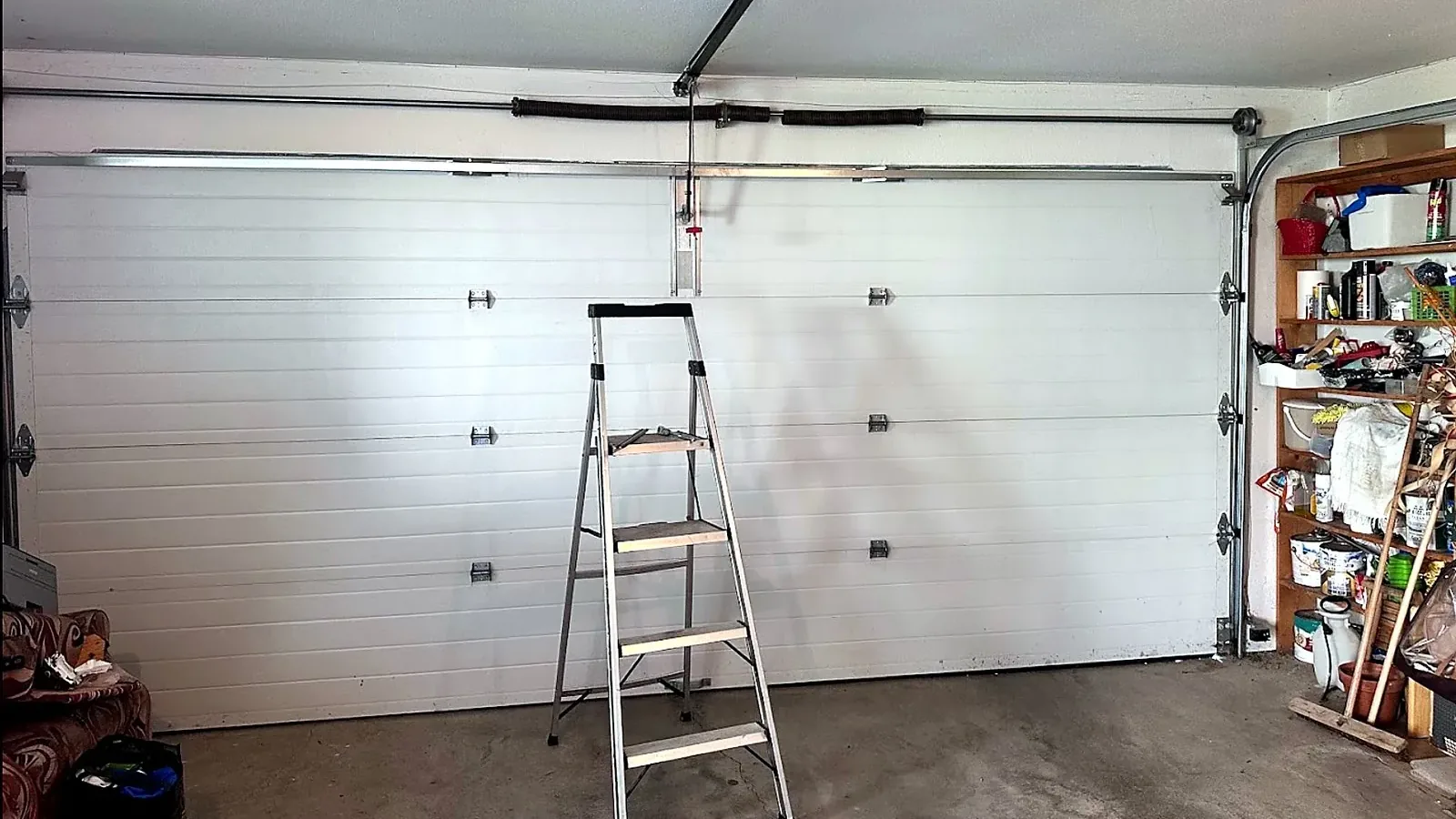
A garage door frozen shut is almost always the bottom seal bonded to the slab. Do not force it with the opener. Pour warm — not boiling — water or a concrete-safe de-icer along the join, free the corners by hand, then lift the door by hand before you touch the motor.
Forcing a bonded seal strips the rubber off the bottom section, and repeated attempts burn out the opener. Both are avoidable with a watering can and a plastic scraper.
How do you unfreeze a garage door stuck to the floor?
- Stop pressing the opener. Every attempt strains the bottom section and loads the motor for nothing.
- Break the bond with warm water. A watering can is easier to aim along the join than a hose. Never boiling: the thermal shock can crack concrete and damage the rubber seal. Dry the join afterwards so it does not refreeze behind you.
- Or use a concrete-safe de-icer. Apply it along the base and give it a few minutes to work before you pull at anything.
- Free the corners by hand. Use a plastic scraper or a stiff brush — never a metal shovel or pry bar against the seal.
- Lift it by hand first. Pull the red release handle, then lift gently. If the door feels light and moves freely, reconnect the trolley and run the opener. If it is heavy, drops, or will not stay halfway up, stop and call.
If the door lifts a little and then stops hard, with no ice in the tracks, it isn't the seal. That's a torsion spring, a cable or a seized roller.
What makes a frozen door worse?
- Boiling water. It can crack cold concrete and damage the bottom seal. Warm is enough.
- A metal shovel or pry bar under the door. You'll tear the seal and dent the bottom panel.
- Hitting the opener again and again. This is the fastest way to turn a ten-minute job into a spring or opener replacement.
- Rock salt against the door. Salt accelerates corrosion on hinges, rollers, cables and the bottom section. Use it on the driveway, keep it off the door.
- Forcing a frozen lock with the key. Warm the key first, or use lock de-icer.
Is it always the bottom seal that freezes?
No. Ice along the base is the usual culprit — and it is what a door frozen to the ground almost always turns out to be — but three other things freeze in a BC cold snap, and each behaves differently.
Snow and ice in the tracks
Packed snow in the vertical channel, usually after driving in with snow still on the roof. The door travels partway and jams. Clear the channel with a brush and warm water, dry it, then check the door runs evenly before you close it again.
Frozen hinges and roller stems
Freezing rain gets into hinge knuckles and roller stems, so the door moves but creaks and drags. Warmth frees them; a cold-rated lubricant keeps them free. Silicone spray and white lithium hold up better in cold than general-purpose oil, which thickens and stops protecting. Put it on the hinges, roller stems and torsion bar bearings — not in the tracks.
The lock or handle
Frozen solid is a lock problem, not a door problem. Warm the key or use lock de-icer and do not force it. If the cylinder has been stiff since the first cold snap, lubricate it before the next one.
Why does my garage door freeze shut so easily in BC?
The Lower Mainland freeze pattern is the problem: rain, then a clear night at −3 °C. Water sits against the seal, freezes, and bonds the rubber to the slab. A door that is fine at −15 °C in dry cold can be stuck solid after a wet night at −2.
Doors facing north or sitting in shade hold ice longer. So do doors at the bottom of a sloped driveway, where meltwater pools against the threshold. Most garage door winter problems start with water that had nowhere to go.
How do you stop a garage door freezing again?
- Check the bottom seal. A cracked or flattened seal holds water against the slab. Replacing it is cheap and is the single best fix.
- Clear the threshold before the overnight freeze, not in the morning.
- Fix the drainage. If water pools against the door, no seal will keep it out indefinitely.
- Lubricate before the first freeze with a cold-rated product, not a summer-weight oil.
- Test the balance in autumn. A door that is already stiff will be the first to give trouble in cold weather.
- Keep the door closed in driving rain so water does not run down into the tracks.
Our winter maintenance checklist covers the rest of the pre-freeze routine, and the cost guide covers what seal and roller work runs.
Is it ice, or is something broken?
A door that will not move in cold weather, with no ice anywhere on it, is usually one of these:
- A torsion spring at the end of its life. Cold does not kill a healthy spring, but it is when a tired one lets go — stiff grease and contracted tracks add load the spring has to carry.
- Seized rollers and thickened grease making the door too heavy for the opener. If it groans or squeals before it stalls, the noise points at the part.
- A force setting that was marginal in summer and is now below what the door needs. Raising it hides the fault instead of fixing it.
- An iced or fogged photo-eye. That stops a door closing, not opening. If yours won't close, start with the sensor checks instead.
If the door opens a few centimetres and stops, or the opener clicks and gives up, treat it as a mechanical fault rather than ice. Our residential repair service covers seals, rollers, cables and springs.
We are in Langley and cover the Lower Mainland. Most winter calls come down to three things: a seal that needs replacing, a spring at the end of its life, or rollers that have seized. Call 604-388-9868 or send a photo of the base of the door and we'll tell you which it is before anyone drives out.
Sources and standards
- 16 CFR Part 1211 — entrapment protection and reversal requirements — the standard behind the safety reverse test after any work at the door
- DASMA Technical Data Sheet 190 — factors affecting spring cycle life — how weather and corrosion shorten spring life