
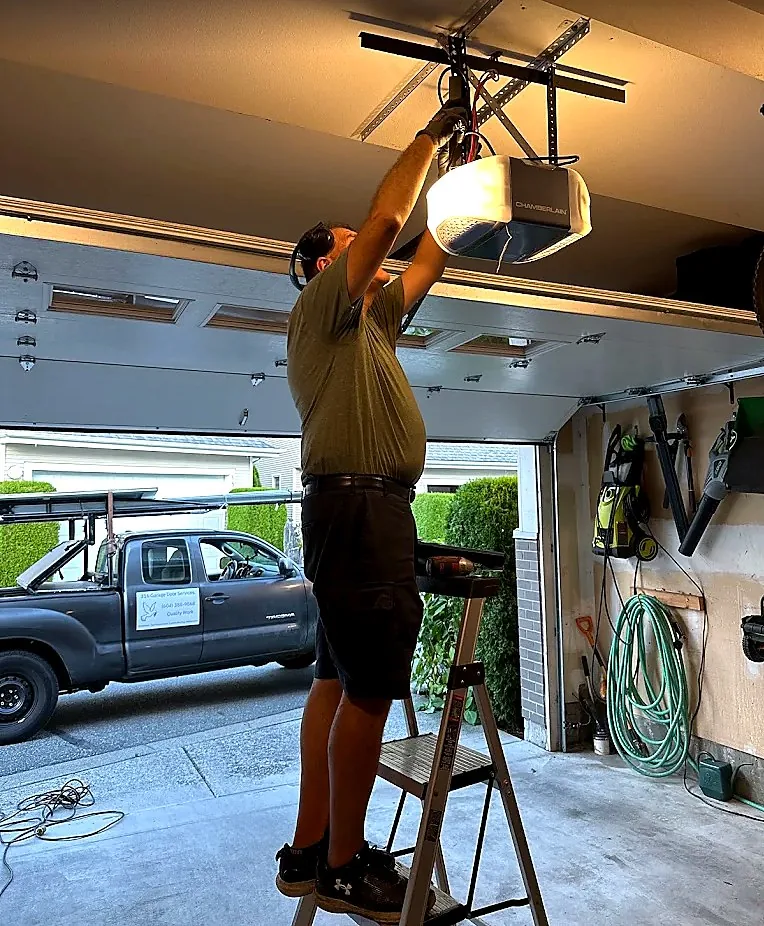
Short answer: for most Lower Mainland homes, a belt-drive opener with a DC motor, battery backup and myQ is the sensible default. Chain drive is the durable budget pick when noise does not matter. A wall-mount (jackshaft) opener is the right answer when ceiling height or overhead storage rules out a rail. Horsepower matters far less than a balanced door.
What should you check before you choose an opener?
Four things decide the answer before a model number matters. Check them in this order, because each one can eliminate a whole category.
- Is the door balanced? Disconnect the opener and lift the door by hand. A balanced door moves easily and stays halfway up. If it drops, fights you or will not hold, the springs are the problem — start with the warning signs of a broken spring — and no opener fixes that. A bigger motor only wears out faster trying.
- How much headroom is above the door? A standard rail opener needs roughly 30 cm of clear space between the ceiling and the highest point of the door's travel, because the rail and the housing hang below the ceiling line. Less than that and the answer changes to something that mounts on the wall.
- What is above the garage? If a bedroom sits directly over the garage, noise becomes a specification rather than a preference. That one fact rules out chain drive in most new Lower Mainland builds.
- How heavy is the door? A single uninsulated steel door and a double insulated door with windows are different loads. Weight is the only reason horsepower exists.
If the door fails any of those checks, fix the door first. The opener is the last component you buy, not the first.
What are the four garage door opener types?
Every residential unit on the market is one of four garage door opener types. What separates them is noise, how much door they can push, and what the installation needs.
| Type | Noise | Best for | Worth knowing |
|---|---|---|---|
| Belt drive | Quietest rail type | Attached garages, a bedroom above, single or double door | Needs correct tension; a squeal is usually alignment |
| Chain drive | Loudest, metallic | Detached garages, heavy doors, rentals | Most durable per dollar; tolerates neglect |
| Screw drive | Quieter than chain | Rare in Canada; specific replacements | Parts and service harder to source here |
| Wall-mount (jackshaft) | Quietest overall; motor on the wall | Low headroom, high-lift track, storage above the door | Torsion springs only; needs side clearance and structure |
Noise is the difference buyers notice first and the hardest thing to judge in a showroom. A sound rating on a box is measured on a test rig, not under your bedroom, so treat the drive type as the better guide.
Belt drive
A reinforced belt instead of a chain. It is the quietest of the rail-mounted designs and the usual choice for an attached garage, especially with a room above. A belt needs correct tension and it does not like being over-tightened; a belt that squeals is almost always a tension or alignment problem rather than a worn belt.
Best for: attached garages, a bedroom above the garage, single or double doors.
Chain drive
The traditional option, and still the most durable per dollar. It is louder — a metallic rumble you hear through the house on a quiet night — but it tolerates a heavier door and a bit of neglect better than a belt. Modern chain units are quieter than the ones people remember from twenty years ago. They are still not belt-quiet, and no amount of marketing changes the mechanics.
Best for: detached garages, budget replacements, heavy doors, rentals.
Screw drive
A threaded rod drives the trolley instead of a chain or a belt. Fewer moving parts, quieter than chain, and it asks very little of the owner. The catch is availability: screw drive is uncommon in Canada, and when a carriage or a limit switch fails, parts can be a wait. That alone is why we rarely recommend it here.
Wall-mount (jackshaft)
A wall mount garage door opener sits on the wall beside the torsion bar and drives the spring shaft directly. There is no rail overhead at all, which frees the ceiling for storage and solves low-headroom garages. It is also the quietest option in practice, because the motor is bolted to the wall instead of hanging from the ceiling above a bedroom.
The catch is structural. A jackshaft needs a torsion-spring door, a torsion bar with clearance at the end, and a mounting point that is actually structure. It cannot be fitted to an extension-spring door, and it is the wrong purchase for a garage with a finished wall and no side clearance.
Best for: low ceilings, high-lift or vertical-lift track, garages used for storage above the door.
Why does the door matter more than the motor?
An opener does not lift your door. The springs do. The opener starts and stops the door, holds it at the limits, and only ever manages the difference between the spring tension and the door's weight. On a balanced door that difference is small, which is why a 1/2 HP unit can run a single door quietly for years.
On a binding door, everything works harder: the gear, the capacitor, the trolley, the rail, the hinges. This is why "my new opener is loud" is usually not an opener problem at all. Worn nylon rollers, a dry hinge, a track knocked out of alignment or a door that has never been lubricated will make the quietest belt drive sound like a freight train.
If a quiet garage door opener is the goal, spend the first money on rollers and alignment — our maintenance checklist has the five-minute monthly version.
Two failures get blamed on the motor constantly. A door that reverses before it reaches the floor is a sensor or a limit setting, and the seven reasons a garage door won't close walks through it. A door that is heavy and drifts down is a spring problem. Neither is solved in the opener aisle.
How much horsepower do you actually need?
Horsepower is the least important number on the box for a healthy door. A balanced single door runs comfortably on 1/2 HP. A double, or a heavy insulated door with windows, is usually better on 3/4 HP. Going bigger does not make a door safer, quieter or longer-lived, and it does not compensate for worn rollers or a spring that is out of adjustment.
What does matter is the motor type. Modern DC motors with soft start and soft stop are quieter and gentler on the door than the older AC motors of the same rating, and they are the reason belt-drive units are as quiet as they are. When two units cost the same, take the DC motor over the extra half horsepower every time.
Which features are worth paying for?
1. Battery backup
When the power goes out, a garage door opener with battery backup still opens. In a Fraser Valley windstorm that is the difference between getting to work and not. It is far cheaper to buy with the opener than to retrofit later, and on the common brands the battery is a factory option rather than something bolted on afterwards.
Two practical notes. A backup battery holds less charge in the cold, so test yours at the start of winter and again in February. And backup is not a substitute for the manual release — know where the red handle is before you need it.
2. Entrapment protection that is installed correctly
Every residential opener sold in Canada is built to ANSI/CAN/UL 325, the binational version of UL 325. It requires two independent layers of protection: an inherent reversing system in the operator, plus a second device — on a residential door, almost always the photo-eye pair at the bottom of the tracks.
In the US, operators manufactured for sale on or after 1 January 1993 have had to include both layers under 16 CFR Part 1211, which requires a closing door to reverse within two seconds of contact with an obstruction. The Canadian standard is the same in substance, so the behaviour in a Langley garage matches one in Bellingham.
The part buyers miss is that the standard covers the installation, not just the box. A photo-eye mounted at knee height or angled at the wall fails the requirement and leaves a blind spot a child can crawl under. DASMA Technical Data Sheet 382 is specific: parallel to the floor, no more than 15 cm (6 in) above it. A quote that offers to skip the sensors because they cause callbacks is not a shortcut, it is a liability.
3. Smart control that works with your phone
myQ is the common option on LiftMaster and Chamberlain units. It gives you open and close from the app, an activity log, and a way to check whether the door is closed without walking outside. That log earns its keep: if the door opens on its own, it tells you whether the command came from a remote, a keypad or the app, which narrows why a door opens by itself in one step.
One installation detail catches people. The myQ hub connects on 2.4 GHz Wi-Fi only. If your router publishes a single merged network name, the hub may never finish setup; a separate 2.4 GHz network, even temporarily, solves it. Plan for that before you are standing in the garage at 9pm.
Modern openers also use rolling-code remotes, which is why a remote from a different brand or an older generation usually will not pair. Ask about remotes and keypad before the install so both are in the quote.
What should you not pay extra for?
- Extra horsepower on a door that is already balanced.
- Premium quiet packages if the garage is detached and nobody sleeps near it.
- Camera or keypad bundles before the sensors work and the door seals.
- A replacement opener when the fault is a worn roller, a seized hinge or a door that needs balancing. Our remote and control troubleshooting guide covers the cheap fixes first.
What does installation actually involve?
An opener install is not bolting a box to the ceiling. A proper job, on a door that is already sound, includes:
- Checking balance and travel before anything is mounted.
- Setting the rail height and header bracket so the door clears through its whole arc.
- Mounting to structure, not drywall or a shelf.
- Wiring the wall control and sensors, and aligning the photo-eyes parallel to the floor and low, per DASMA's guidance.
- Setting open and close limits, then the force, then testing the reverse on a 38 mm obstruction.
- Pairing remotes, keypad and myQ, and walking the homeowner through the monthly test.
Budget half a day for a straightforward replacement. It runs longer if the door needs balancing first, the ceiling is finished, or there is no power where the opener needs it. Our residential opener and door installation page covers what we check before we leave.
When is a new door the better buy?
If the door is dented, rusting through the bottom section, or has bent the same track twice, an opener upgrade is money spent on the wrong component. Our guide to repairing versus replacing covers where that line falls, and the Langley cost guide covers what the work actually runs.
One local pattern is worth knowing. Townhouse complexes built here in the 1990s often have extension springs and a finished garage ceiling. That combination rules out a jackshaft and limits rail clearance, so the honest recommendation is usually a belt drive on the existing rail, not a wall-mount.
What is the best garage door opener for a Langley home?
For a typical Langley or Surrey home with an attached garage and a sound door: belt drive, DC motor, 3/4 HP, battery backup, myQ, installed with new rollers and a properly tensioned spring. It is quiet enough for a bedroom above, works in an outage, and gives you an app log the next time the door misbehaves.
If the garage is detached and you want the cheapest reliable option, chain drive is not a compromise — it is the correct tool for that building. If the ceiling is low, the door is high-lift, or you store things above the door, ask about a wall-mount before anything else.
That is the honest version of “best garage door opener”: the best one is matched to the door, the ceiling and the room above it. A ranked list of models cannot tell you that, and a bigger motor cannot fix it.
We install and service LiftMaster and myQ systems across Langley, Surrey and the rest of the Lower Mainland. Call 604-388-9868 or send us a photo of your ceiling and door and we will tell you which type fits — before you buy.
Sources and standards
- 16 CFR Part 1211 — entrapment protection and the two-second reversal rule — what every residential opener sold in the US is required to do
- DASMA Technical Data Sheet 382 — photoelectric sensor installation height — parallel to the floor, no higher than six inches
- UL Solutions — ANSI/CAN/UL 325, the US/Canada binational operator standard — the two layers of protection in plain terms
- UL Standards & Engagement — how automatic garage door standards work — why the second layer exists