
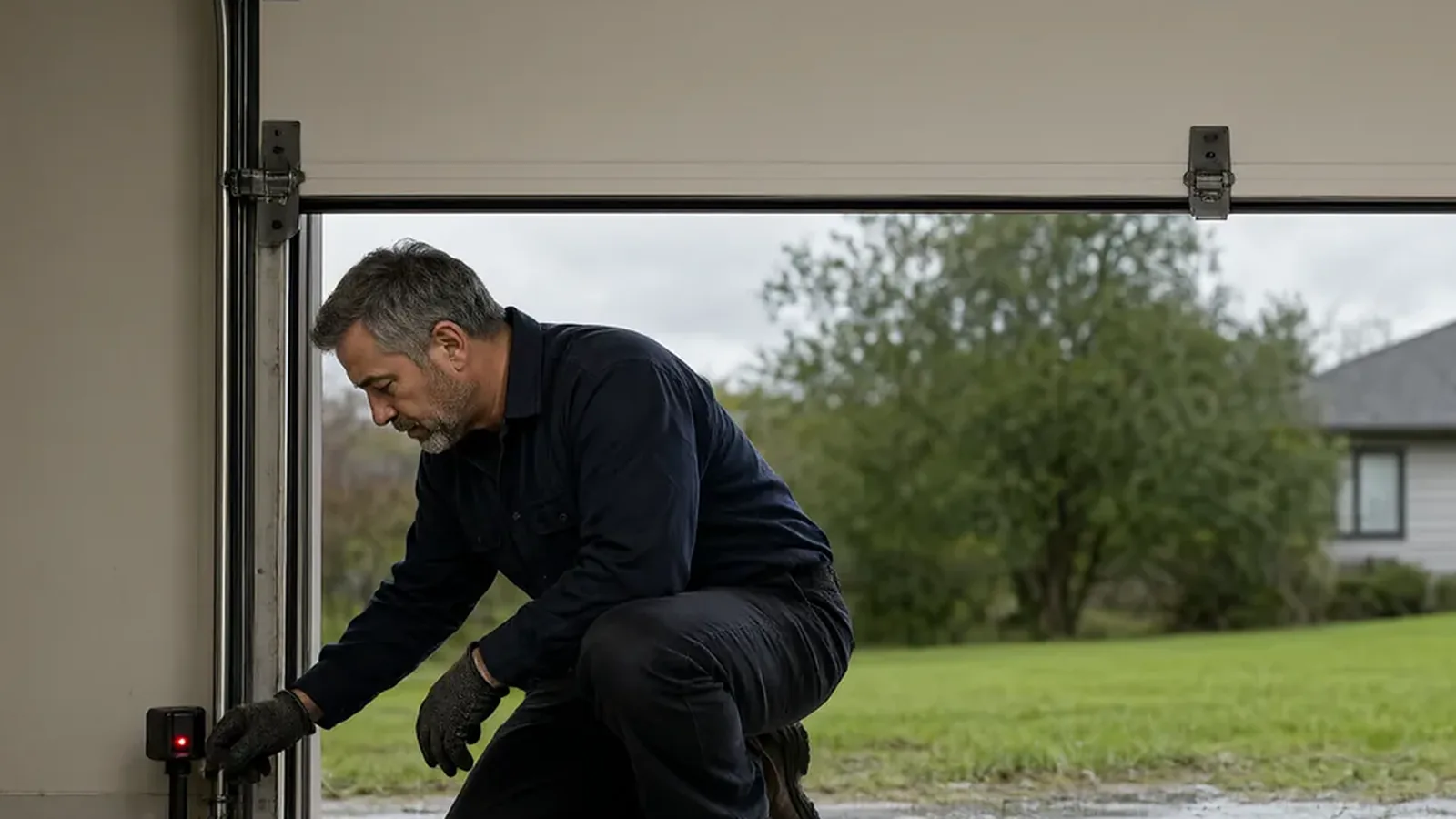
A garage door is safe for kids and pets when two things are true: it reverses within two seconds of touching something, and the photo-eyes sit no more than 6 in (15 cm) off the floor. Test the first with a 2x4 laid flat in the opening, 38 mm (1.5 in) high. Check the second by eye — both sensor lights lit and steady. Those two checks take a minute. The other five are habit, maintenance, and knowing what not to touch.
Why the standard exists
In a December 1991 release, the US Consumer Product Safety Commission reported that 48 children aged two to 14 had died after becoming entrapped under automatic garage doors since 1982. That count is why entrapment protection became mandatory on openers sold in the US, and why the rule that followed added a second, independent layer of it.
The rule has two parts. Every operator needs an inherent reversing system, plus a second layer of entrapment protection — in practice the photo-eye pair at the bottom of the tracks. In the US, operators manufactured for sale on or after 1 January 1993 must meet 16 CFR Part 1211, which adopts UL 325. Openers sold in Canada are built to ANSI/CAN/UL 325, the binational version of the same standard, so the behaviour on a Langley door is identical.
The performance test is specific: a closing door must begin to reverse within two seconds of contact with an obstruction. That is a physical check you can run yourself in under a minute, which is what the rest of this page is about.
1. Test the safety reverse
- Open the door with the wall control.
- Lay a 2x4 flat on the floor in the middle of the opening. Laid flat, it is 38 mm (1.5 in) high.
- Close the door. It must reverse on contact with the wood — not press down on it, not stop, reverse.
- Remove the wood and open the door again.
Most owner's manuals ask for this once a month, and it takes under two minutes. If the door fails, stop using the opener until it's fixed. This isn't a "get to it this weekend" item.
2. Check the garage door safety sensors
The two small sensors at the bottom of the tracks send an invisible beam across the opening. Break the beam and it won't close. They are the second layer of protection, not the only one.
- Both LEDs should be lit and steady when the opening is clear. A light that is dark, or that flickers when you pass a hand through the beam, is a fault.
- Ignore the colour. On LiftMaster and Chamberlain sensors one light is amber and the other green, and that is normal. What matters is both on, both steady.
- They should be low. DASMA's installation data sheet for photoelectric sensors (TDS 382) is written for commercial doors, and it states the rule plainly: parallel to the floor, no more than 6 in (15 cm) above it. Residential brackets land in the same range. Sensors sitting at knee height are mounted wrong, and a crawling child or a cat passes underneath.
- They should be clean and pointed at each other. Cobwebs, road salt spray and a bumped bracket are the usual culprits.
Do not tape over, bypass or disconnect a sensor. A door that closes because the safety system was defeated is the exact scenario the standard was written to prevent. A sensor that keeps faulting needs replacing, not disconnecting.
3. Put the wall button out of reach
UL 325's installation instructions put the wall control at least 5 ft (1.5 m) above the floor, within sight of the door and clear of moving parts, specifically so a small child cannot reach it. If yours is at toddler height, moving it is a small job and worth doing.
Children treat wall buttons and remotes as toys because they look like toys. Two rules cover the everyday risk: nobody plays with the door, and nobody stands in the opening while it moves. Keep remotes out of reach, and use the lock or vacation mode on the wall station when the garage is not in active use. If you have a keypad outside, change the PIN from the default and don't share it with a child old enough to use it unsupervised.
4. Keep the travel path clear
The area under and beside the door should be empty of bikes, bins, tools and toys. It isn't only about the door hitting something — an object left in the opening can hold the beam or block the reverse test without anyone noticing.
5. Respect the pinch points
Section joints, the gap between the door and the jamb, and the hinge line are where fingers get caught. Small hands go into gaps that adults don't see. Stand back and look at the door from a child's height: the bottom section and the side gaps are the two places to check.
6. Know where the release is, and when not to use it
The red manual release handle disconnects the door from the opener so it can be moved by hand. The standard requires the handle to be red and capable of being adjusted to 6 ft (1.8 m) above the floor. Teach older children what it does and that it is not a game. Never pull it while the door is open and unbalanced, because the door can drop.
7. Keep pets out of the cycle
A cat or a small dog walking through the opening may not break a beam that sits at ankle height, and a pet lying in the doorway is invisible to the opener. The reliable protection is a visual check before every close, and a rule that pets stay inside until the door has finished moving.
Closing from an app or a timer counts as unattended operation, and the standard makes the opener flash and beep before it moves. A light and a beep mean nothing to a sleeping dog. Look at the opening before you tap close, and switch the schedule off while pets or small children are loose in the yard.
The garage door safety checklist, in one table
Print this, or screenshot it and keep it in the garage.
| Check | What passing looks like | How often |
|---|---|---|
| Safety reverse | Door reverses on a 38 mm (1.5 in) board instead of pressing on it | Monthly |
| Sensor height and LEDs | Both lights steady, lenses no more than 15 cm (6 in) off the floor | Monthly |
| Wall button and remotes | Button at least 1.5 m (5 ft) up, remotes out of reach | Once, then yearly |
| Travel path | Floor clear, nothing leaning on the tracks | Every close |
| Pinch points | No fingers at the section joints or the jamb gap | When children are in the garage |
| Manual release | Red handle at about 1.8 m (6 ft), nothing stored against it | Twice a year |
| Pets and app closing | Eyes on the opening before every close, no auto-close while pets are loose | Every close |
What not to let anyone do
- Hang from the door, ride it, or use it as a swing.
- Race under a closing door — the failure the standard was written for.
- Stand on a ladder in the door's travel path.
- Attempt spring or cable work. A torsion spring under tension, or the cable that runs with it, holds enough energy to break bones or kill.
- Leave a door partly open and unattended if it drifts or will not stay up. That is a spring or balance failure.
What to check once a year
- The door is balanced: disconnected, it should lift easily and stay halfway.
- Rollers, hinges and cables show no wear, slack or fraying.
- The door closes flat, with the bottom seal compressed evenly.
- The opener's force setting has not been turned up to compensate for a stiff door.
- Nothing has been stored against the tracks or hung from them.
Most of that is covered in our maintenance checklist, and the balance test is the same one that tells you whether a spring is failing.
When to call someone
- The reverse test fails and the sensors are clean and aligned.
- The door is hard to lift, drifts down, or will not stay halfway up.
- A cable is slack or frayed, or the door is crooked.
- The opener closes the door only while you hold the button.
- The door has come out of its track.
A door that only closes while you hold the button is usually reporting a sensor fault. Our guide to a garage door that will not close starts from the same checks, in the order we find them.
We test and adjust all of this on a normal residential service visit, and we run the reverse test with you so you can repeat it yourself. Call 604-388-9868 or send us the details, and tell us whether kids or pets use the garage — we will check the sensor height first.
Sources and standards
- 16 CFR Part 1211 — Safety Standard for Automatic Residential Garage Door Operators — effective 1 January 1993, the two-second reversal rule, the two protection layers, the 5 ft wall control and the 6 ft manual release
- DASMA Technical Data Sheet 382 — photoelectric sensor installation height — sensors parallel to the floor and no higher than six inches
- CPSC release 92-024 — garage door child entrapment deaths since 1982 — the history that produced the current standard
- UL Solutions — ANSI/CAN/UL 325, the binational standard applied in Canada
- UL Standards & Engagement — automatic garage door standards — how the two layers of entrapment protection work, and the warning required before app closing